
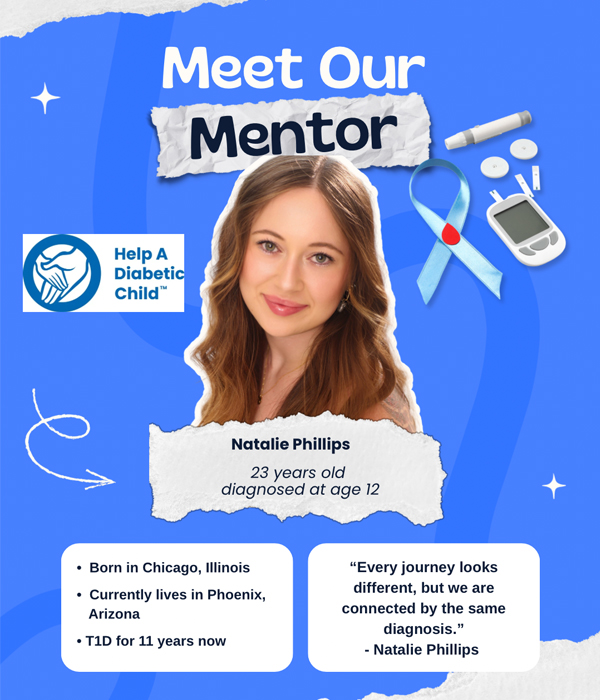
Hi! My name is Natalie Phillips. I’m 23 years old, currently living in Phoenix, and I’ve been living with Type 1 Diabetes for the past 11 years.
I want to share my story from the very beginning—buckle in, because it’s a wild one.
I was born in Chicago, Illinois, and when I was 11, my family decided on a whim to move to Scottsdale, Arizona. Shortly after the move, I began experiencing symptoms of undiagnosed diabetes, though I didn’t realize it at the time. The first noticeable change was a loss of motivation. I had just started middle school, but I disliked it so much that I asked my mom if I could switch to online schooling for the rest of the year because I felt like I didn’t fit in. She agreed and helped me enroll.
From that point on, things began to spiral. I lost interest in almost everything. I was constantly fatigued, slept until noon most days, stopped doing my schoolwork, and ended up failing all my classes—something that was completely out of character for me. I also started losing weight, felt thirsty all the time, and was using the bathroom constantly. Because we had just moved from a humid climate to the dry Arizona heat, the thirst and frequent urination were brushed off as environmental. When my mom took me to the pediatrician, my symptoms were interpreted as depression, and I was prescribed Prozac.
A few months later, we moved again, this time to the suburbs of Illinois for my dad’s job. I started sixth grade halfway through the year and quickly made a close friend. One night, she came over for dinner and, before eating, pulled out a kit and pricked her finger to check her “blood sugar.” I had never seen anything like it. My mom explained that she had diabetes and mentioned that my great-grandfather had Type 1 as well. At the time, I just thought it was strange.
Meanwhile, my symptoms were getting worse. My constant thirst and frequent urination intensified, and I lost about 15 pounds. Then one morning, I experienced what I now recognize as severe vision disturbances. I woke up and couldn’t see the fan above my bed—it was as if it had disappeared. Moments later, my vision refocused and it was there. I brushed it off, but it happened again later that day while I was watching the trailer for Paddington. I looked at my dad and asked, “Where is the bear?”… even though it was clearly on the screen. Concerned, my dad thought I might have low blood sugar and tried to get me to eat. When the episodes continued, he called my mom, and she immediately told him to take me to the ER.
At the hospital, they ran several tests and initially concluded that I was just dehydrated. They gave me fluids, had me drink Gatorade, and prepared to discharge me. But before I left, they asked for a urine sample “just to be safe.” About ten minutes later, a group of medical professionals came back into the room and asked to check my blood sugar. I remember thinking about my friend and her finger prick from a few weeks earlier. When they tested me, my blood sugar was 375. They found ketones in my urine and diagnosed me with Type 1 Diabetes. My A1C was 15.
At the time, I genuinely thought it might be contagious—after all, the first time I had heard about diabetes was just weeks earlier from my friend. My doctor explained that wasn’t the case.
One of the hardest parts of being diagnosed as a child is how suddenly your entire world changes, without fully understanding why. My doctor wasn’t very kid-friendly, and I felt confused and uncomfortable trying to process everything he was telling me. My mom became my translator—she learned everything from the doctor and then explained it to me in a way I could understand. She bridged that gap for me, and I was incredibly lucky to have that support. Not every child does.
Even at that age, I began to understand how important communication is in healthcare. When providers fail to meet patients, especially children, where they are it can create fear, confusion, and disconnection. Medical knowledge means little if it isn’t communicated with empathy and clarity.
Even now, I sometimes struggle to find care that makes me feel truly heard and understood. That’s why the Type 1 Diabetes community is so important. We rely on each other—through shared experiences, mentorship, and storytelling. Every journey looks different, but we are connected by the same diagnosis.

